Thursday, January 12, 2012

2,500 less puppies will be born in 2012 in just one day of the clinic

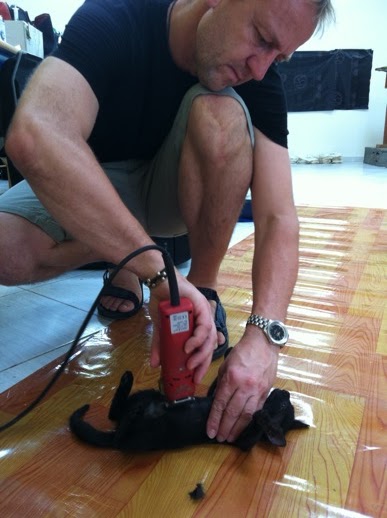
The fourth sterilisation clinic organised by SOS Cães e Gatos (Cats & Dogs) started yesterday.  The clinic is part of a strategy to reduce the dog and cat population of Sal in a humane way.  The vets that come over from Germany are specialists in this sort of work and travel all over the world helping associations in this way.  Because they are such experts it is possible to perform many operations each day - it is almost like a production line, with the best German efficiency!  The wonderful veterinarian Ines Leuw can sterilise a female dog in less than eight minutes!

Recently there was a lot of discussion, led by the hotels on Sal, about the creation of a 'kennel' that would be built and run by the City Hall.  This kennel would be out in the middle of the desert and the dogs would be collected from the hotels and held there for an unspecified time when the owners must collect them and pay a fine.  If they are not collected then they would be killed.  This not very well-conceived plan has so many problems that it is hard to know where to start, but here are a few;
  1. Who will collect the dogs, since many strays are not approachable?
  2. Which dogs will be collected?  Will the neutered dogs be included?  How to determine if dogs are owned or not?
  3. Who will take care of the dogs?  Where will the money come from to feed & water them?
  4. What if people cannot reach the kennel or do not have money to pay the fine?
  5. How will they be killed and who would do it?  There would be no humane way since the veterinarian would not kill healthy animals.
A family of ginger kittens recovering from their operation
This 'solution' is really just a death sentence for the dogs, but in a less obvious way than the still-used practice of throwing meat laced with strychnine on the beaches.  As one hotel manager stated ' Yes, the dogs will be killed, but it will be less difficult for the tourists to deal with'.  In other words, for everyone it would be a case of out of sight out of mind.

The problem is of course that this is only a short term 'solution' and therefore not really a solution at all.  As quoted many times on this blog, the World Health Organisation states that 'no extermination of dog populations by poison, shooting or other means, has every succeeded anywhere in the world'.

Therefore the aim is to sterilise as many dogs & cats as possible and programmes such as this carried out on islands have a special chance of success.  Since there are few new dogs wandering on to the island (unless they swim from Boa Vista!), the results can be quite dramatic.  

The veterinarians at work
In just the first day 30 females were sterilised.  These 30 females could have two litters (of 6 puppies) during 2012, if 6 of these were female, they could also have 12 puppies this year.  That means in theory

30 x 12 = 360 puppies
50% female = 180 who then have 12 puppies of their own = 2,160
Total new dogs prevented in just one year = 360+2,160 = 2,520

There is no way that an extermination programme could get anywhere close to this efficiency!

Strange how the Capeverdean people who line up outside the clinics each day can follow this logic, but the mostly European hotel & restaurant owners & managers can't seem to grasp the concept!!


The clinic runs in Santa Maria (opposite the old May O'Leary's) until the 15th January and then at Africa 70 in Espargos from the 17th - 22nd.  Call 957 2162 for more information.

Wednesday, November 30, 2011

How to help the cats and dogs


So many kind visitors come to Sal and take pity on the cats and dogs they see on the street and in their hotels.  Unfortunately this is not always the best policy since large congregations of animals inside hotels causes problems with hygiene and complaints from other guests.  Not all people love animals and it can be intimidating to see large groups of dogs wandering around, especially if you are not familiar with the country.  When this happens, as for instance, on the beach at the RIU, some people feel that there needs to be an 'instant' solution, such as with the mysterious disappearance of the seven puppies that were born under a boat there about three months ago. 

Since no one wants this kind of inhumane treatment, new association SOS Cats & Dogs recommends that tourists do not feed the animals in or around hotels or allow dogs to follow them back to their hotel.  Instead guests can help by making a donation of money or much needed treatments for parasites such as fleas, ticks & mange.

The hotels also need to take some responsibility in this matter, such as limiting the access for dogs (such as erecting a fence as the Belorizonte recently did), placing information for guests & training staff.  In addition the association can supply ultra-sonic animal deterrents which discourage animals from entering the area.  Incidentally these hand-held units work really well for joggers or bike riders who don't welcome the local dogs running alongside them!

For more information email SOS Cats & Dogs

Saturday, October 8, 2011

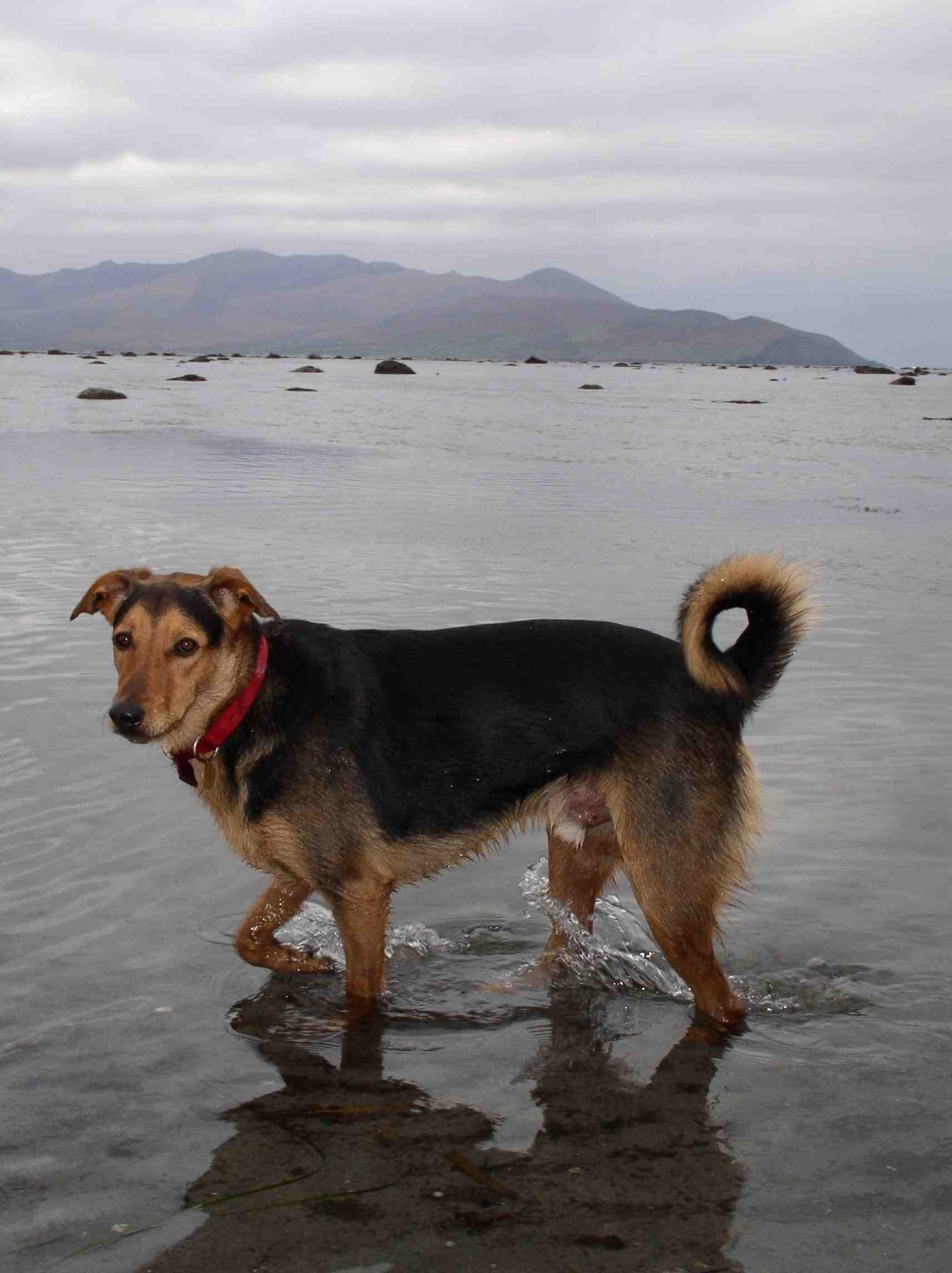
Two years since Rasher was killed

In Ireland near where he was born
Today is a terrible anniversary for us.  At this time on 8 October 2009 we had no idea that our world was about to be turned upside down by the irresponsible actions of a single person.  Yesterday in 2009 was the day that Giorgio Chiarel, the manager of the RIU hotel in Sal authorised the Delegation of Health to place strychnine on the beach outside Sal's largest hotel.

By 5pm the following day our beautiful dog, Rasher, had eaten that poison.  By 5.10pm he had died a horrendous, painful death in the turtle hatchery in front of many of the RIU hotel's guests. 

There are some who will never understand that love for an animal can be as strong as love for another human but there is no doubt that Rasher was our family, part of our world and we will never be the same without him.  Not a day goes by without us mourning his loss.  Our lives are diminished by the sadness that we have in our hearts every day.

This is made even harder by the recent pushing by some hotels and restaurants for yet more killing of animals.  Their idea?  A kennel in the desert, thinly disguised as a humane option, but in reality a place out of the view of tourists where animals can be killed.  As one hotel manager told me "yes Jacquie, it is the same, but less hard for people to deal with or know about, since it is not happening on the beach in front of people." 

Sleeping peacefully in the turtle hatchery
Clearly not many of the managers or owners have learned anything at all.  Not only this, but they can hide their involvement since although it is the hotels and restaurants pushing the government to build this concentration camp, it would be the City Hall kennel and they can claim to have nothing to do with it.

Always happy to get a ride on the quad
Indeed, in a recent email the Public Relations Depart of the RIU head office stated that they do not get involved in this issue but must respect the actions of the local government.   Therefore, once again refusing to accept any responsibility in the death of who knows how many dogs in the years since they opened here on Sal and conveniently forgetting that it was they, not the government, who requested poison to be placed on the beach in 2009.

There is only one way to control free roaming animal populations and that is a sustained neutering programme coupled with public education.  This includes advising hotel and restaurant guests not to feed dogs (which causes animals to congregate in unmanageable groups) and closing access to premises.

Thankfully the current manager of the RIU is more enlightened and is planning on using ultra sonic dog deterrents and giving more information to guests as well as allowing the dog and cat association to fundraise at the hotel..

As for Giorgio Chiarel?  Any reprimand from the RIU hotel?  Not at all, instead a reward - the manager's job at the new RIU Touareg on Boa Vista.

Thursday, October 6, 2011

And the poisoning continues

Despite the results achieved with three sterilisation clinics (1000+ animals neutered so far), it seems the message is still not reaching some individuals, businesses and organisations.

The recent calls for the removal and destruction of free roaming dogs in Santa Maria simply has no merit.  Poorly thought out, it will no doubt be poorly executed as well.

Which dogs will be removed?  Will this include owned, registered and neutered dogs?  How long will they be held for?  Who will kill them and by what method?  (It certainly won't be by lethal injection since there is no Euthanol here and no staff trained to administer it).  Since there is no law here to say that you must keep your dog in your house or on a lead, how can this be legal?

And how will this solve the problem?  Natures abhors a vacuum.  Soon the areas where the dogs were taken from will be repopulated and the cycle begins again. 

For many it is a case of 'out of sight out of mind' and this is typical of the short-termism that afflicts many people here.  The answer?  If you don't want dogs and cats in your restaurant or hotel, close off access, ensure that food is not available and support neutering clinics.

In the meantime, it seems things are worse in the residential area of Murdeira which is notorious for poisoning animals.  Cape Verde Pets

Saturday, September 10, 2011

A story to warm the heart, Fenix the dog that wouldn't die

The saddest little dog used to live near us.  Fenix, with his back legs paralysed, dragging himself around with his front legs, living disabled on the street.  But who was sad?  The little dog?  No!  Fenix was happy and playful and loved.  It was only my own feelings that made me unable see anything else but his suffering and not see his big heart and his strong will to live.

So many people thought it was wrong to let him live this way, with no hope of recovery and (as some may have thought) no quality of life.  But a few people with huge hearts refused to give up and saw in this little dog a survivor's instinct - and knew that he deserved to be helped.

This is the story of Fenix's life (with apologies to Surfactivity for the poor translation):

"Better to be born lucky than rich"

Fenix has survived:
  • 1st assassination attempt hit by a car at Vila Verde = FAIL (result: paralyzed lower limbs) 
  • 2nd attempt to murder by lethal injection = FAILED (abandoned in the desert hoping that soon the injection would kill him) 
  • 3rd attempt to murder through neglect again in the desert = FAILED (recovered and dragged himself back again) 
  • 4th attempt to murder by suffocation = FAILED (Tossed into a plastic bag to suffocate, but released in time) 
  • 5th attempt again by lethal injection = FAILED (recommended by veterinarians who thought it inappropriate for him to live in this condition) 
  • 6th assassination attempt by poisoning = FAILED (found in time and saved)
And after all this, his relentless will to live and our care have been rewarded. 

Tonight Fenix ​​flew to Italy, thanks to the Association Vita Animale in Milan where they will try to cure his paralysis or look for someone to care for him.

Fenix on his way to the airport in the back of Francesco's truck
Fenix's treatment has already begun and he has found a place with the other dogs.  The seventh miracle in his short life is the friends that he had living in Santa Maria and their relentless quest to help him.

I, who doubted and was even scared to look at him through my own fear and pity for him, salute you Pat, Nicky, Francesco, Debora and all others who fought for his survival.


Good luck Fenix!

Monday, July 11, 2011

Third sterilisation clinic on Sal

It is an incredible experience to be part of the team running the dog and cat sterilisation clinic here on Sal.  Our wonderful veterinarians Thomas, Ines, Corinna and Madueno work non-stop, sometimes performing as many as 60 operations in a day.
Surgery production line
 And meanwhile, outside the clinic there is a steady flow of people of all ages with dogs and cats of all shapes, sizes and age.  They wait patiently, sometimes for most of the day to improve the lives of their animals by preventing unwanted puppies and kittens.

Incredible to see butch men with their butch dogs being brought for castration and knowing that the doubters who think that Caboverdean people don't care about their pets or don't understand the benefits of sterilisation, are SO WRONG!
No animal too small
 Incredible to see a hardened fisherman cradling a tiny kitten.

Little starving street dog, I am in love again
Incredible to see so many people loving their animals!

 See some more photos here.

Read more about SOS Cats & Dogs Cabo Verde here.

A video about the clinic in Praia run by the same vets before they came to Sal.

Tuesday, May 24, 2011

Cat beaten to death by Santa Maria restaurant owner

Some stories are so shocking it is hard to believe they are true and so horrific they are painful to read.


Last Friday, in front of horrified staff & diners, the owner of Restaurant Funana d'Vila in the town square of Santa Maria (Sal Island, Cape Verde) brutally killed a cat that had the misfortune to wander into his restaurant.

According to eye witnesses, the owner, Walter Dahringer, a German national, enticed the cat by offering it food, before snatching it up and throwing it in a blue plastic carrier bag.  He then repeatedly beat the bag on the stone pavement, ignoring the screams of agony of the cat inside.  When the cat was finally dead he simply tossed the bag inside a rubbish bin near his restaurant.

A volunteer retrieves the cat's body from the bin
Since animal welfare laws in Cabo Verde are unclear (they only protect owned animals which are classed as your property), it seems unlikely that there will be any action taken by the authorities.

The bin is near a trailer used by the restaurant.  Ironically 'Cretcheu'  is a term of endearment, such as 'sweetheart'


The restaurant Funana d'Vila.  The volunteer is blacked out for fear of reprisals
However, businesses like this survive by their reputation and we invite you to make your feelings known by boycotting this restaurant and spreading the word amongst others who live on or visit Sal.

You may also like to express your feelings to Mr Dahringer via email.  The address can be found on the internet.

Let's send a message that this kind of behaviour is unaceptable.

You can also sign a petition against the poisoning of cats and dogs in this country here. Stop poisoning cats and dogs in Cabo Verde.